
Future Product Ideas
Tools for projects that are more than notes and files.
BurningForge is being designed as a project-first platform. These ideas describe future tools that could help makers, engineers and developers organize, visualize, simulate and reuse real engineering work.
Context
Why project ideas matter
BurningForge is not meant to become only a forum, a file storage system or a simple project notebook.
The long-term goal is to create a workspace where project information is connected to useful engineering tools.
A project should be able to contain not only text and attachments, but also structured modules, interactive models, simulations, reusable components, documentation, build logs and collaboration context.
This page collects product ideas that may become part of BurningForge as the platform grows.
Idea 01
Programmable circuit simulation workspace
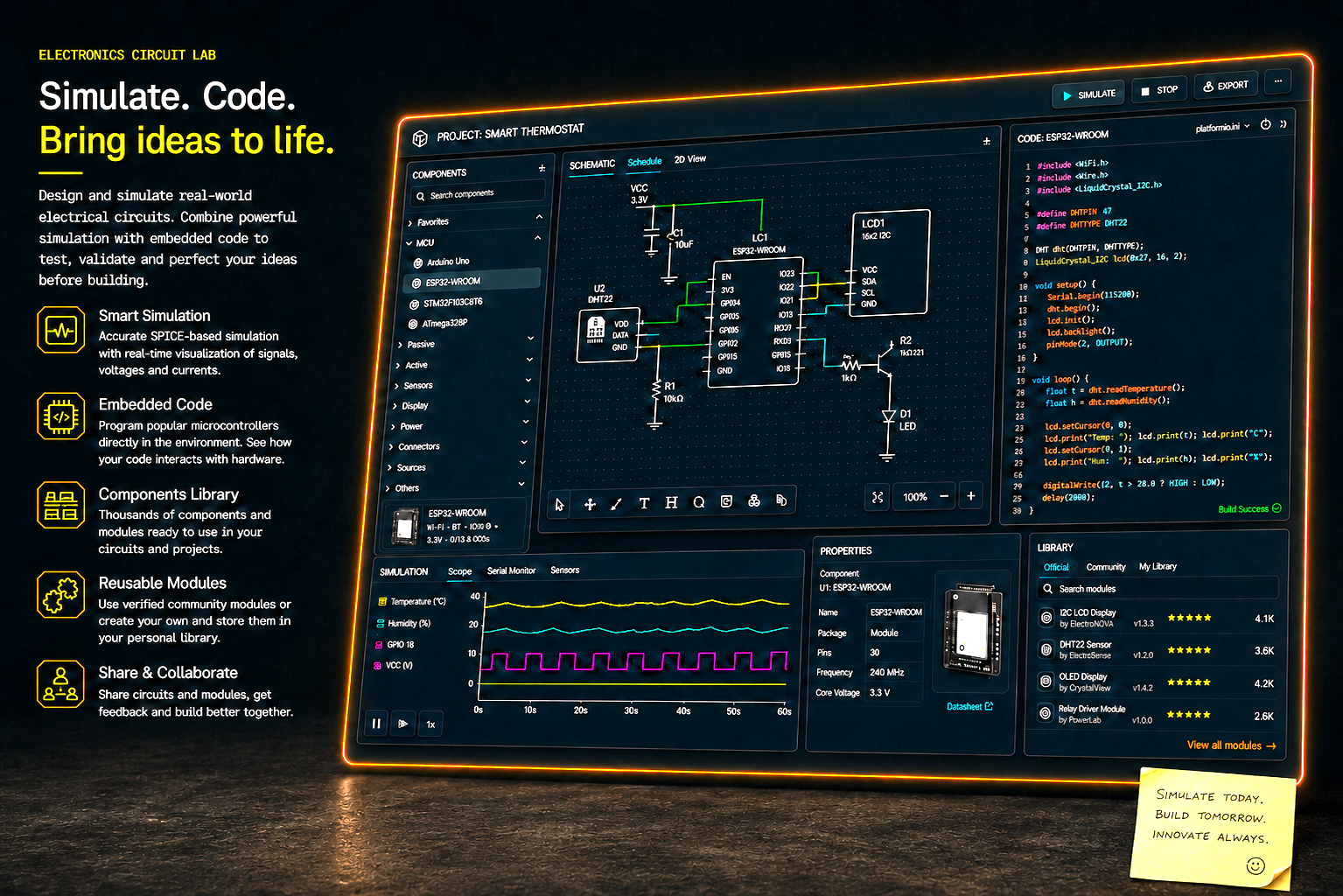
One of the most important future BurningForge ideas is a programmable electronics simulation workspace.
The goal is not just to draw a circuit diagram. The goal is to make electronics part of the project workflow.
A project could include a circuit, microcontroller code, reusable modules, component data, signal visualization, test notes and links to related mechanical or 3D parts.
Instead of keeping schematics, firmware, sensor notes and test results in disconnected tools, BurningForge could let users keep them connected inside one Project Block.
What it could include
- interactive circuit diagrams
- reusable electronic modules
- microcontroller-oriented workflows
- embedded code examples
- simulated signals and sensor data
- component libraries
- project-specific test logs
- links between circuit modules, firmware, documentation and 3D parts
- shared community modules that users can reuse in their own projects
Example use case
A user could design an ESP32-based controller, connect sensors and a display, write basic firmware, simulate expected behavior, document the result and later reuse the same controller module in another project.
For a beginner, this could become a guided learning tool. For an experienced maker, it could become a way to document and validate reusable project modules.
Why it fits BurningForge
Many DIY and engineering projects fail not because the idea is bad, but because the electronics, code and documentation become separated too early.
A programmable simulator would help users understand how a system works before physical assembly, while also keeping decisions, test results and reusable modules inside the same project context.
Idea 02
3D model workspace connected to the project
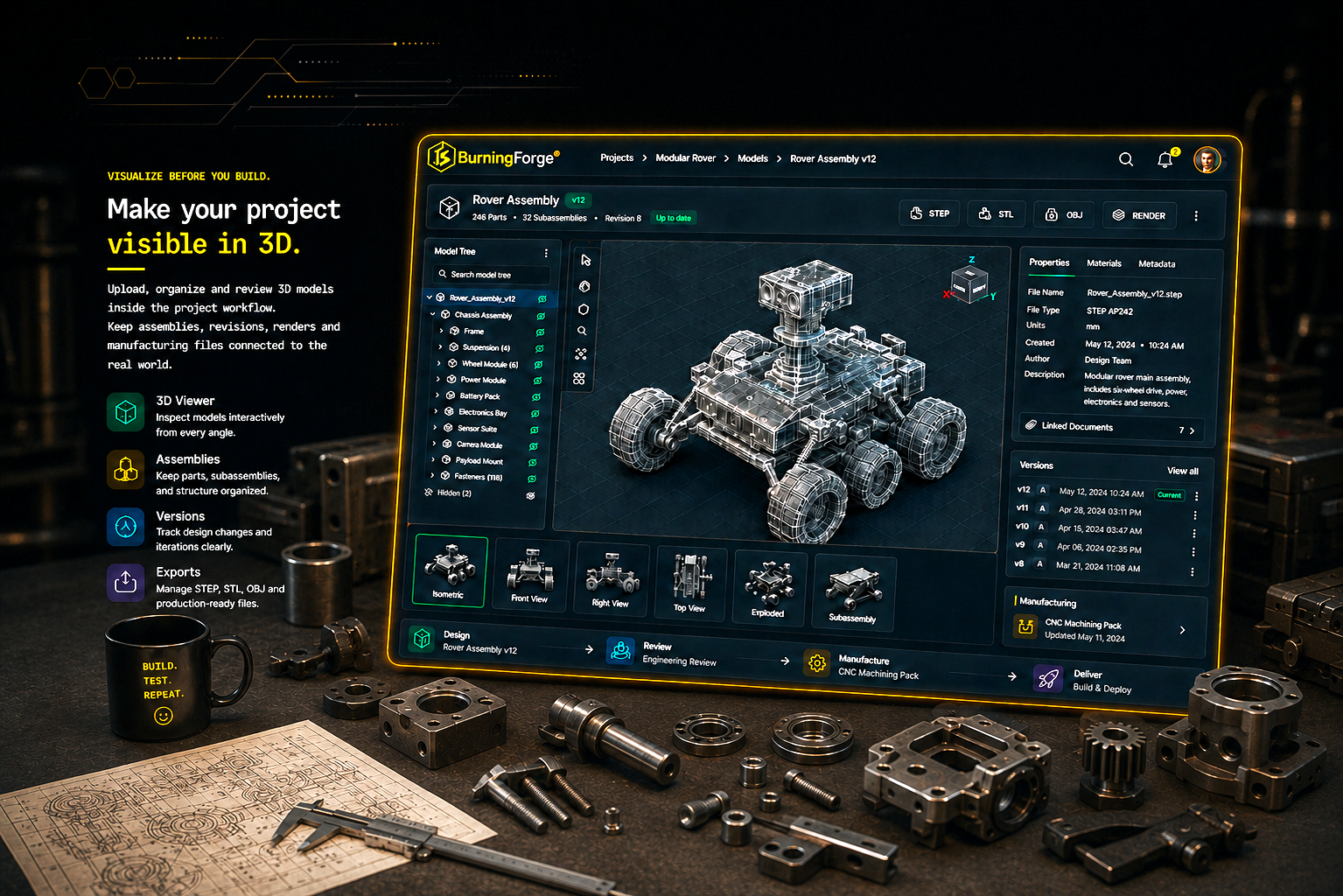
Another future idea is a 3D model workspace for viewing, organizing and discussing project models directly inside BurningForge.
This would not try to replace professional CAD tools at first. Instead, it would make CAD files easier to understand, review, document and connect to the rest of the project.
A project could contain 3D assemblies, part versions, renders, manufacturing notes, related files and links to electronics or simulation modules.
What it could include
- 3D model viewer for project files
- support for common formats such as STL, OBJ, STEP or GLB
- assembly and subassembly organization
- model version history
- exploded views and annotations
- links to drawings, BOM items and manufacturing notes
- public previews for open projects
- private review mode for personal or team projects
Connection with the simulator
The real power appears when the 3D workspace and simulator are connected.
For example, a user could design a mechanical enclosure, place a controller board inside it, link that board to a programmable circuit module, document cable routing, mark sensor positions and keep related firmware notes in the same project.
This would help users understand not only what a part looks like, but how it works inside the whole system.
Why it fits BurningForge
Engineering projects are rarely only mechanical or only electronic.
A useful project platform should help users see the relationship between parts, circuits, code, documentation and production decisions.
The 3D model workspace would make projects more visual, easier to explain and easier to collaborate on.
More concepts
More ideas are being explored
BurningForge is still in early development, and these concepts are not final product promises.
More ideas are being explored step by step, including better documentation tools, project timelines, build logs, reusable modules, BOM tracking, public project pages, collaboration features and marketplace-style opportunities for useful engineering skills.
Build the direction
Help shape the future of BurningForge
The best product ideas should come from real projects, real problems and real people who build things.
BurningForge is being shaped openly, one step at a time.